Volume drift kills yield in high-speed micro-dispensing. As a production shift progresses, the internal temperature of a standard dispensing valve rises. Fluid viscosity drops. A target deposit of 2.0 nanoliters slowly expands to 2.3 nanoliters, and eventually, fluid bleed ruins a tight-pitch component.
Most operators fight this thermal drift by manually adjusting valve stroke or fluid pressure every few hours. This is downtime masquerading as maintenance. Operators are guessing at the right pressure adjustments to compensate for changing fluid mechanics, leading to inconsistent dot profiles across different shifts and different machines.
Yield drops in precision manufacturing rarely happen because a valve fails completely. They happen because the valve loses its baseline. In applications using UV-cure adhesives, silver epoxies, or underfill materials, the tolerance for fluid volume variation is practically zero. If a dot is too small, the structural bond fails. If it is too large, the material spreads into exclusion zones and shorts adjacent pads.
High-speed operations expose the mechanical limitations of traditional pneumatic and standard piezoelectric valves. After a million cycles—which can take less than an hour in a high-volume line—wear on the tappet and nozzle seat slightly alters the fluid path. The physical stroke length changes by just a few microns. That microscopic change drastically alters the volume of the jetted droplet.
To eliminate this variable, engineers specify a micro-dispensing repeatability valve capable of closed-loop correction. Upgrading means moving away from systems that rely on human operators to recognize and correct volume drift, and implementing hardware that maintains its own mechanical baseline regardless of environmental temperature or cycle count.
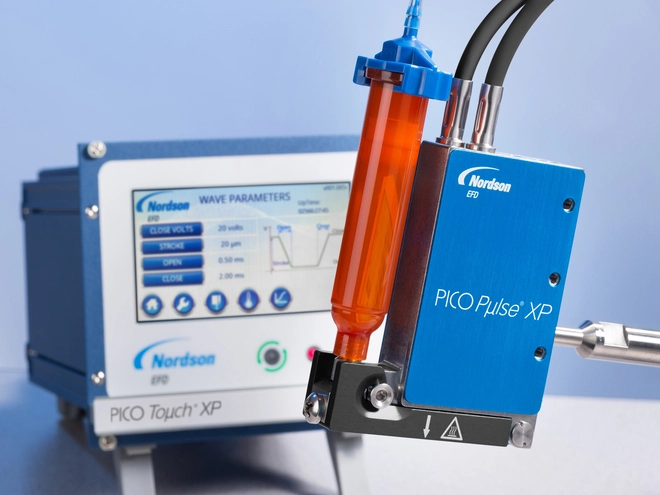
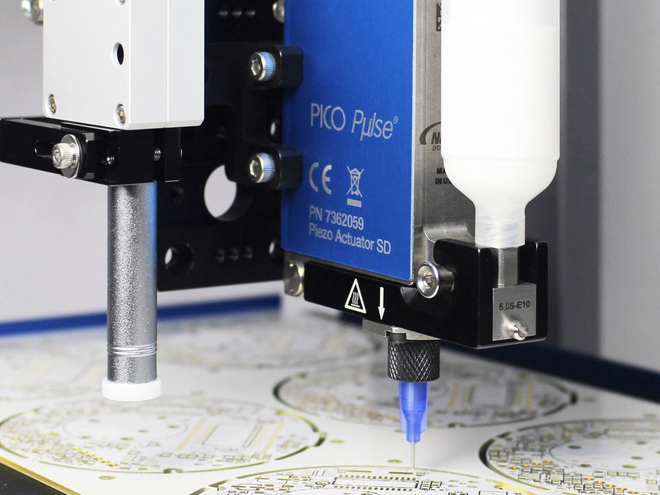
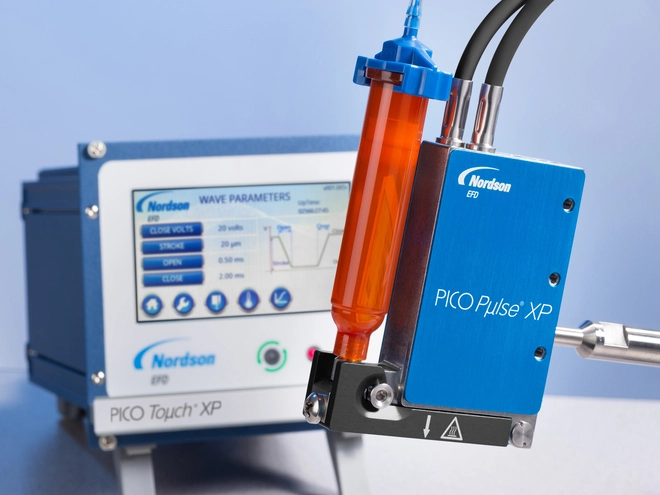
The PICO XP Jetting System uses piezoelectric actuation to fire fluid droplets without contacting the substrate. A ceramic stack expands rapidly when voltage is applied, driving a tappet into a nozzle seat to break the fluid stream. The 1000Hz jet dispensing valve operates at 1,000 cycles per second. Speed is an obvious advantage for throughput, but raw speed without control just produces defects faster.
The core technical advantage of this system is its self-regulating calibration jet valve technology. Standard piezo valves require manual calibration routines where an operator stops the line, measures the stroke with an external micrometer, and manually updates the software. The PICO XP automates this entirely.
The system maps its own optimal stroke profile during the initial setup. As the valve operates, the internal temperature fluctuates and mechanical components undergo micro-expansion. The self-regulating mechanism detects these minute changes in real time. It automatically adjusts the voltage sent to the piezoelectric stack to ensure the tappet travels the exact same distance, with the exact same force, on cycle ten million as it did on cycle one. The droplet volume remains locked.
Consistent delivery also requires a stable material supply. The PICO XP fluid tank assembly isolates the fluid from shop-air fluctuations, providing a highly regulated pressure feed to the valve body. If the fluid pressure drops, even the most precise valve will misfire.
You must plan for the physical realities of high-speed jetting. Jet valves demand stringent fluid homogeneity. A single trapped air bubble acts as a pneumatic spring inside the fluid chamber, absorbing the force of the tappet and causing a missed shot. Filler particles that exceed the nozzle orifice diameter will cause immediate clogs. Upgrading to the PICO XP requires you to audit your material handling, degassing, and filtration processes—the valve cannot compensate for poorly prepared fluids.
Different production environments stress dispensing systems in entirely different ways. The configuration that works for a printed circuit board (PCB) assembly will fail in a cleanroom.
In semiconductor packaging, the primary challenge is space. Die attach and wafer-level underfill applications require dispensing highly engineered, expensive epoxies into cavities measured in microns. The high-speed jet dispensing equipment excels here because non-contact jetting eliminates the need for Z-axis movement. The valve hovers above the substrate, firing precise volumes without risking a needle collision with fragile wire bonds or delicate silicon dies.
Automotive electronics assembly presents a different set of failure modes. When sealing Advanced Driver Assistance Systems (ADAS) camera modules or potting Engine Control Units (ECUs), the challenge is maintaining consistent dispense weight over large, complex geometries while using highly viscous, abrasive thermal interface materials. The self-regulating stroke of the valve prevents the abrasive fillers from eroding the nozzle seat and gradually increasing the dispense volume, which would otherwise lead to messy squeeze-out during final assembly.
Traceability is no longer optional in automotive and medical device manufacturing. If a component fails in the field, you must be able to prove that the exact volume of adhesive was applied to that specific serial number.
The Nordson PICO Toμch XP controller acts as a data node on the factory floor. It does not just drive the valve; it records the operating parameters of every cycle. Modern Manufacturing Execution Systems (MES) require this data. By utilizing standard industrial protocols, the controller feeds real-time stroke data, temperature readings, and calibration logs directly into your factory's data lake.
If the valve detects a calibration error it cannot self-correct, the controller flags the MES to instantly halt the line. This closed-loop communication prevents a single clogged nozzle from churning out thousands of defective boards before a human operator notices.
Specifying the right valve is only half the engineering challenge. Procuring it in time for New Product Introduction (NPI) is the other.
Original Equipment Manufacturer (OEM) lead times for precision fluid handling equipment routinely stretch past 12 to 16 weeks. Production schedules do not pause for supply chain delays. When an unexpected line expansion is approved or a legacy valve fails catastrophically, waiting three months for a replacement halts revenue.
CHUANGKAIDA operates as a stocking PICO Pμlse XP jet valve supplier. By maintaining a deep inventory of base systems, controllers, and fluid reservoirs, CKD bypasses standard factory delays. This allows US and global manufacturers to secure the hardware required for immediate line integration rather than gambling on extended OEM delivery dates.
Buying a bare valve rarely solves a dispensing problem. The system requires a specific combination of tappet geometry, nozzle orifice size, and fluid heating parameters tailored to your exact material.
CKD provides the engineering bridge between purchasing the hardware and achieving stable production. This includes matching the valve configuration to your fluid's rheology, determining the optimal pulse time and voltage settings, and defining the maintenance intervals required to keep the system running. You receive a system configured for your specific application, rather than a box of parts that your engineers must figure out from scratch.
Capital expenditure budgets dictate how manufacturing lines scale. While buying new equipment offers the longest predictable lifespan, it is not always the most efficient use of capital.
Purchasing a new system guarantees the latest firmware, complete warranty coverage, and zero wear on critical components. This is the standard choice for permanent installations in greenfield factories where the equipment will run continuous shifts for five to seven years.
Sourcing a used PICO XP dispensing system cuts capital requirements by a significant margin. This route is highly effective when duplicating an existing, stable production line. Because CKD refurbishes and recalibrates these units to factory specifications, you achieve the same volumetric repeatability without the premium of new hardware. The primary trade-off is a shorter overall lifecycle before a major rebuild is required.
Not every dispensing requirement justifies a permanent capital purchase. A PICO XP jetting system rental provides immediate access to high-end dispensing technology without the long-term financial commitment.
Evaluate a rental program if your operational scenario matches these conditions:
Renting transfers the maintenance and depreciation risks away from your balance sheet. If your production requirements shift, you simply return the hardware. To review available configurations or secure immediate inventory for your facility, explore the PICO XP Jetting System specifications and deployment options.