The short answer: the iJet-9 is a candidate for high-speed precision dispensing, but application testing should decide the purchase
Yes—if your process needs fast automated motion, precise positioning and production-line integration, the iJet-9 deserves evaluation. It should not be approved from a specification sheet alone.
The published 0.02 mm repeatability, 800 mm/s maximum movement speed and 1.0 g maximum acceleration describe motion-system potential. They don’t establish deposit weight stability, bead geometry, corner quality, cycle time or yield with your fluid and parts. Those outcomes depend on the valve, material behavior, dispense path, substrate condition, fixturing and process settings.
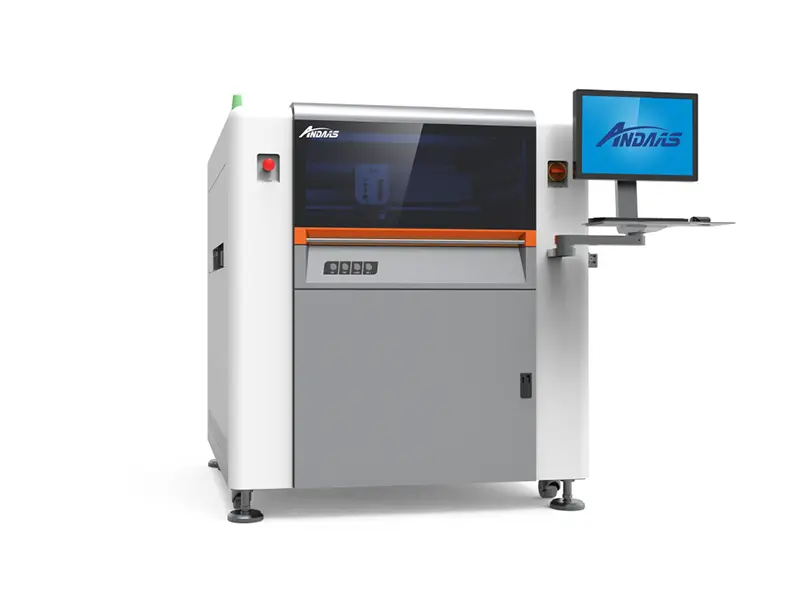
Treat the iJet-9 Fully Automatic High-Speed Dispensing Machine as a platform to qualify, not a finished process that can be selected by headline speed.
What the published dimensions, repeatability, speed and acceleration reveal—and what they do not prove
CHUANGKAIDA publishes four useful baseline specifications for the iJet-9:
| Published item | What it helps you assess | What still requires verification |
|---|---|---|
| Machine dimensions: L1400 × W1260 × H1380 mm | Initial floor-space, doorway and rigging review | Service clearance, control-cabinet access, conveyor extensions and operator space |
| Repeatability: 0.02 mm | Ability of the motion system to return to a commanded position | Absolute accuracy and completed-deposit variation on actual parts |
| Maximum movement speed: 800 mm/s | Potential for rapid travel between dispense locations | Sustainable speed while dispensing and complete machine cycle time |
| Maximum acceleration: 1.0 g | Potential to shorten non-dispense moves | Effects on wet material, flexible substrates, fixtures and dispense quality |
Maximum axis speed is not throughput. A production cycle may also include board transfer, barcode reading, image acquisition, alignment, height measurement, valve actuation, cleaning and downstream handshaking. Ask the supplier to break out these time elements during testing.
The machine dimensions aren’t the installed footprint, either. The published iJet-9 specifications give you the main enclosure size; your layout review still needs loading access, maintenance clearance and upstream or downstream equipment.
Single-valve and dual-valve configurations change dispensing travel, process flexibility and qualification requirements
CHUANGKAIDA lists different dispensing travel for single- and dual-valve versions, so buyers shouldn’t assume identical usable work envelopes. Obtain the exact X, Y and Z travel for the quoted configuration and compare it with part dimensions, fixture borders, conveyor rails and calibration locations.
A dual-valve mechanism may support two materials, two dispense methods or parallel processing, depending on the engineered setup. It also adds collision-clearance, offset-calibration, maintenance and recipe-control questions. Both valves must be qualified separately and then tested together under production timing.
Production fit depends on the fluid, substrate, dispense pattern and automation scenario
The right automatic adhesive dispensing machine for electronics is chosen around the process, not around nominal axis performance. Start with the material’s viscosity range, filler content, cure behavior, pot life, tendency to string or drip, and sensitivity to temperature or moisture. Then define the required dot, line, dam, fill or coating pattern without assuming one valve type will handle all of them.
Substrate condition matters just as much. Warped printed circuit boards, reflective surfaces, inconsistent component heights and poorly controlled fixtures can consume the positioning margin suggested by motion repeatability. Small deposits near connectors demand different controls from broad coating paths or underfill work.
The iJet-9 may suit electronics, semiconductor packaging, automotive, medical or industrial applications, which are markets CHUANGKAIDA serves. That doesn’t mean one configuration is automatically suitable across those sectors. Cleanliness, material compatibility, traceability and validation obligations vary sharply.
Qualify vision positioning, laser height measurement, board handling, barcode traceability and conveyor integration as configuration-specific capabilities
CHUANGKAIDA’s product vocabulary includes CCD vision positioning, laser height measurement, barcode scanners, board handling and conveyor integration. Buyers should not assume every function is standard on every quotation.
For a vision-guided dispensing system, test recognition on real surfaces, including dark solder mask, glare, variable markings and partially obscured fiducials. Height measurement should be checked against board warp and component geometry. For conveyor use, confirm board-width range, transfer direction, edge clearance, SMEMA or other required handshaking, stop position and recovery after a fault.
Barcode validation should cover code type, reader location, failed-read behavior and recipe lockout. Traceability has little value if an unreadable code lets the machine run under the wrong program.
A representative sample trial should establish process capability and measurable acceptance criteria
Send production-representative parts, fixtures and fresh material from the intended supply chain. A polished demonstration coupon hides the problems that appear on molded housings, populated boards and variable incoming lots.
The trial protocol should define acceptable deposit location, volume or mass, bead width and height, start-and-stop quality, voids, tails, overspray and substrate contamination. It should also record cycle time, material waste, cleaning frequency, nozzle or valve maintenance and fault recovery. Run enough consecutive parts to expose drift, not just enough to produce an attractive video.
Test edge conditions: minimum and maximum part variation, material near its permitted working-life limit, restart after a pause, changeover between recipes and recovery after a board-transfer error. Save the approved recipe, images, measurement data and sample identifiers. That package becomes the basis for factory acceptance and site acceptance rather than relying on subjective statements such as “dispense looks good.”
A United States deployment requires documented electrical, safety, installation and import planning
A machine that performs well at the supplier’s site can still miss its U.S. launch date because the facility requirements were reviewed too late. Ask for electrical drawings, utility loads, equipment weight, lifting points, exhaust needs, network interfaces and installation conditions before releasing the purchase order.
Import planning should identify the importer of record, shipping terms, tariff classification responsibilities, crating method, insurance, delivery point and rigging scope. Clarify who pays when a crate arrives but the receiving dock can’t unload or move the machine.
Confirm site power, utilities, ESD controls, guarding, applicable UL or NRTL requirements, compliance records, commissioning, training, spare parts and service response
Do not infer U.S. compliance from an enclosure label or component mark. Have your safety team, authority having jurisdiction and insurer determine whether the complete machine needs UL or another NRTL evaluation. Request available compliance records and perform a documented machine risk assessment covering doors, interlocks, emergency stops, moving axes, electrical panels and maintenance access.
For electronics production, verify how the quoted system fits your facility’s ESD control program. Confirm grounding points, dissipative contact surfaces and handling practices instead of treating “ESD-compatible” as a complete specification.
CHUANGKAIDA describes services including process verification, customization, installation, commissioning, spare parts and after-sales maintenance. Put the purchased service scope in writing: training hours, language, remote access method, on-site response, warranty exclusions, recommended spares and lead times for critical valves, controllers and motion components.
Final decision checklist: compare the validated process, standard and optional scope, total ownership costs and quote exclusions before approving the iJet-9
Use the final quotation and sample report to answer these questions:
- Did the system meet deposit-quality and cycle-time criteria with production parts and material?
- Does the quoted single- or dual-valve work envelope clear the product, fixture and conveyor rails?
- Are vision, height measurement, barcode reading, board handling and conveyor interfaces listed as included, optional or excluded?
- Are site power, utilities, ESD provisions, guarding and applicable U.S. evaluation requirements documented?
- Does the price include fixtures, valves, feeders, software, freight, duties, rigging, installation, training and acceptance testing?
- Have you budgeted consumables, cleaning labor, preventive maintenance, spare parts and production downtime?
- Are process ownership, warranty coverage and service-response commitments written into the order?
An iJet-9 automatic dispensing system quote is ready for approval only when its configuration matches the validated sample process and every material exclusion is visible.