News

What Type of Precision Fluid Dispensing System Fits Your Electronics Process?

2026-09-07 0 Leave me a message

Start with the fluid behavior and the board access—not the dispenser brand or the number of axes on a brochure. Needle dispensing is usually the right answer for a controlled bead or contact application. Jetting earns its place where Z-axis contact is risky or physically impractical. Coating systems suit broad, repeatable coverage patterns, while multi-lane platforms address throughput only after the dispensing method is proven.

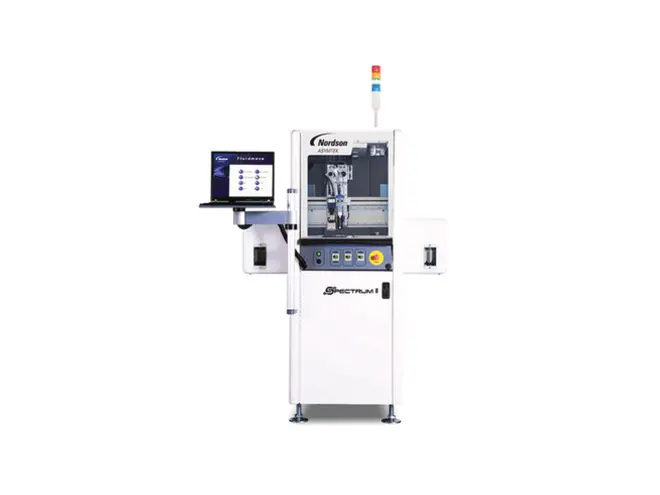
That distinction matters on real electronics lines. A machine that handles PCBA underfill well may be a poor fit for a thin sealing line around a connector, and a fast jetting cell will not correct a coating recipe with weak edge definition. The ASYMTEK Spectrum II S2-900 precision fluid spraying system belongs in the evaluation when its available process controls and material-handling configuration match the job—not simply because it is a recognized platform.

Choose the Application Method by the Process Problem, Not the Machine Name

The defensible classification is application method: how the fluid reaches the part. That choice governs access, deposit shape, material tolerance, inspection needs, and the kind of production interruption you are likely to face. A needle, a jet valve, and a coating applicator can all dispense material accurately. They do not solve the same failure mode.

Needle dispensing for controlled contact applications and defined bead paths

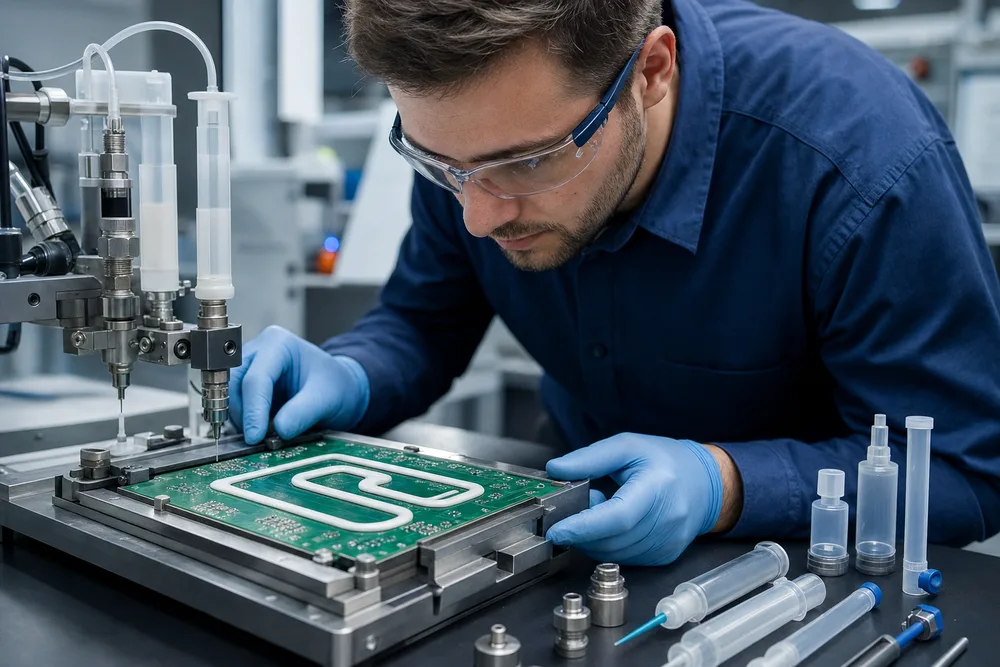
Needle dispensing puts the outlet close to the target and is commonly selected for defined bead paths, localized fills, and applications where the process requires controlled contact with the part. It is a practical route for many underfill operations, solder-paste sealing tasks, and perimeter seals.

The trade-off is clearance. Board warp, component-height variation, lifted leads, or an inaccurate height map can turn a good program into a scraped component or a smeared bead. Buyers sometimes focus on XY path accuracy and overlook needle-to-board distance control. On a narrow gap, that oversight can show up as inconsistent wetting, intermittent contact, or damage that only appears after assembly.

Jetting for non-contact deposits, confined access and tight board geometries

Jetting transfers material without bringing a needle down to the board. That makes it useful around tall components, inside congested layouts, and on targets where a needle cannot safely approach. For precision dispensing equipment used on dense consumer-electronics boards, non-contact operation can remove a major collision risk.

It is not a universal upgrade. The material must suit the valve, and the deposit must be qualified for volume, placement, satellite droplets, and repeatability at the intended temperature. A jet process also demands careful attention to valve maintenance and fluid conditioning. If the material separates, skins, or changes viscosity during a shift, speed will only produce bad parts faster.

Match the Platform to Underfill, Narrow-Gap Dispensing, Sealing or Precision Coating

Different applications ask different questions of the same platform. For PCBA underfill, look at how the material flows under the package, the required path around the device, thermal control, and inspection of void-related defects. A narrow-gap process raises the stakes on access, stand-off, needle size or non-contact placement, and repeatable fluid delivery. Do not assume that a system demonstrated with a large bead can hold a stable result on your smallest clearance.

For automated solder-paste sealing, the key question is usually bead continuity at starts, stops, corners, and connector transitions. A nominally accurate path is not enough if the bead necks down at a corner or leaves a tail at valve close.

Precision coating is a different discipline. You need to define keep-out zones, edge coverage, film uniformity, cure compatibility, and how the program handles board fiducials and component variation. The Spectrum II S2-900 platform category is associated with features such as three-axis control, high-resolution vision, heating, flexible needle applications, and jetting dispensing. Treat those as configuration questions. Verify which functions are installed and operational on the particular machine under review.

The Process Variables That Change the Equipment Decision

Five variables tend to move a buyer from one dispensing approach to another:

  • Fluid response: Viscosity alone is not enough. Ask how the material behaves at operating temperature, after idle time, and under pressure or valve actuation.
  • Target geometry: Measure clearance to neighboring parts, component heights, access angle, and the smallest feature that must receive material.
  • Deposit requirement: Define whether the job needs a dot, a continuous bead, a filled channel, or a controlled coating pattern—and how it will be inspected.
  • Board variation: Warpage, panel flatness, fiducial quality, and incoming board tolerances often determine whether contact dispensing is stable.
  • Production flow: Board size, changeover frequency, queue behavior, and upstream/downstream handoff determine whether conveyor and lane options are worth paying for.

Closed-loop process control can be valuable, but it does not replace material qualification. It helps a process remain within its programmed control strategy; it cannot make an unsuitable chemistry dispense cleanly or compensate for a poorly designed bead path.

How to Evaluate a Spectrum II-Class System for Production Readiness

Ask for a demonstration using your substrate, or a representative coupon with the same component density and surface finish. A dry motion demo proves very little. The review should include startup, purge, first-article output, normal cycling, a planned pause, and restart. Watch the actual deposit under the same lighting and inspection method your line will use.

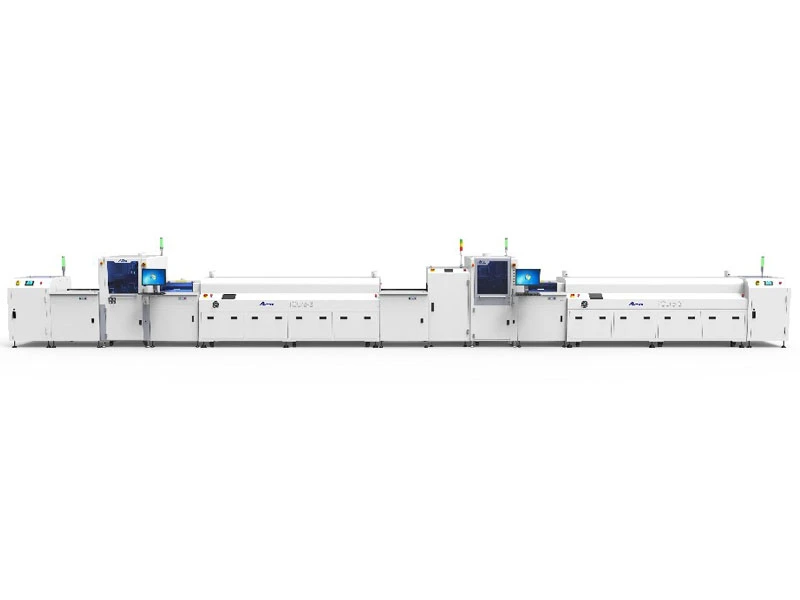
For a Spectrum II-class system, confirm the dispensing head or valve arrangement, available needle and jetting capability, vision setup, heating provisions, conveyor arrangement, and software access. CHUANGKAIDA identifies options such as single-channel processing, dual-aisle conveyors, pre- and post-queue stations, and dual simultaneous dispensing in its Spectrum II coverage. Those options affect line balance, but only if they are fitted to the machine and useful for your product mix.

A dual-lane fluid dispensing system can improve output where boards and recipes truly run in parallel. It can also complicate loading, recipe control, maintenance access, and recovery after a stoppage. If your constraint is material stabilization or inspection time, adding lanes may not be the answer.

Questions to Ask About Configuration, Condition, Service and Spare Parts

Is this exact machine configured for needle dispensing, jetting, coating, or some combination? Request the installed configuration and a clear account of what is included. “Capable of” and “installed on this unit” are not the same statement.

What was the system's prior process and maintenance history? Used equipment can be a sound choice, especially for a qualified legacy process, but old materials can leave contamination in wetted paths. Inspect valves, fluid lines, fittings, pumps, filters, and the condition of motion and conveyor components.

Who supports installation and recovery? CHUANGKAIDA offers new in-stock machines, used-machine trading, rental arrangements, spare parts, and engineering or turnkey support. For a used ASYMTEK Spectrum II system or rental unit, establish the scope of commissioning, training, parts availability, and fault response before release of the purchase order.

Can the supplier run the intended material? This should include compatibility with wetted components, cleaning method, and the process temperatures you expect to use. Material data sheets are a starting point, not final proof.

A Practical Pre-Quote Checklist for Electronics Dispensing Automation

  • Provide board drawings, component-height data, fiducial locations, and clear photos of the target area.
  • State the fluid, storage rules, cure method, and any supplier handling limits.
  • Define the acceptable deposit shape and the inspection method used to approve it.
  • Identify the smallest clearance, tallest nearby component, and board-warp condition the process must tolerate.
  • Specify required throughput, but separate true cycle-time demand from loading, curing, and inspection delays.
  • List required configurations: needle, jetting, heating, vision, conveyor, queue stations, or dual-lane handling.
  • For used or rental equipment, require a configuration list, condition review, startup support plan, and spare-parts path.

If you can answer those points, you are ready to compare a needle dispenser, jetting system, precision coating platform, or multi-lane production cell on process fit rather than sales terminology.

Related News
Leave me a message
X
We use cookies to offer you a better browsing experience, analyze site traffic and personalize content. By using this site, you agree to our use of cookies.Privacy Policy