The ASYMTEK Vantage Series is a configurable precision fluid dispensing platform for electronics assembly, semiconductor packaging and other production processes that need controlled material placement, process correction and traceable operating data. It should be considered when a manual dispenser or basic automated valve cannot provide the required repeatability, throughput, keep-out-zone control or factory-system connection.
CHUANGKAIDA supplies new equipment, rentals, used-machine options and turnkey engineering services for the ASYMTEK Vantage Series dispensing system. The available configurations are Essential, High Volume, Productivity and Productivity Plus. The right choice depends on your material, deposit geometry, valve strategy, production rate and integration requirements—not simply on choosing the highest configuration.
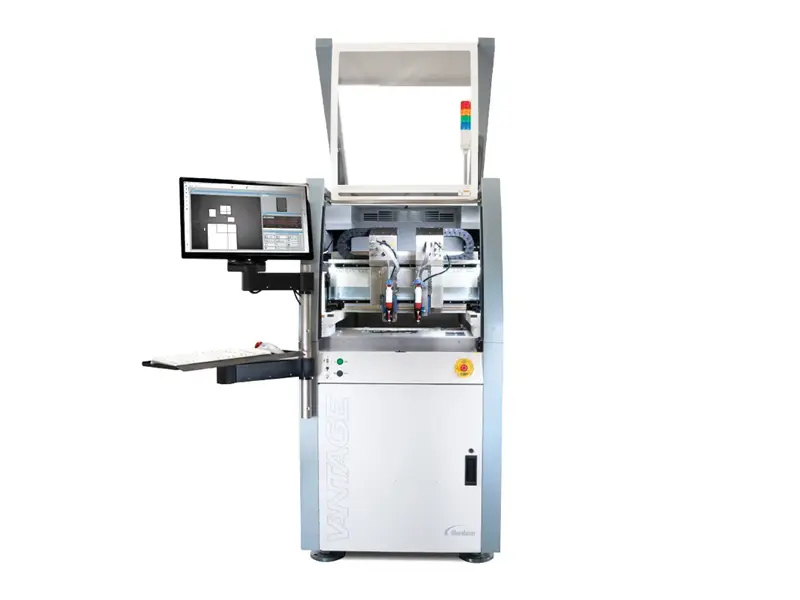
A configurable precision dispensing system for controlled, traceable electronics production
Vantage systems bring dispensing hardware, motion control, valve operation and process software into one production platform. Documented capabilities include single- or dual-valve operation, automatic calibration, closed-loop control, real-time correction and data traceability. Canvas dispensing software supports programming and process operation, while ASYMTEK NE Connect can provide FIS or MES connectivity.
That combination matters when the dispense result must remain consistent across shifts, product changeovers or production lots. It also gives process engineers a clearer record of what the machine did. Traceability does not prove that every deposit met specification, however. Your acceptance plan still needs measurable criteria for material placement, deposit size, cycle time and reject handling.
How IntelliJet, automatic calibration and closed-loop correction support repeatable dispensing
IntelliJet is the platform’s named jetting capability. Jetting ejects controlled deposits without requiring the valve tip to touch the workpiece, which can help around fragile components, uneven surfaces and restricted access areas. The practical result depends heavily on fluid behavior. Viscosity, filler content, temperature sensitivity, cure response and exposure time can all affect jetting performance.
Automatic calibration reduces reliance on an operator manually recovering the process reference after setup or changeover. Closed-loop control and real-time correction then allow the system to respond to monitored process conditions instead of running indefinitely from an unchanged initial setting. Ask which variables are measured, how corrections are applied and what events are recorded; those details can vary with the installed hardware and software scope.
These controls improve process discipline, but they cannot rescue an incompatible fluid, unstable substrate or poorly defined dispense target. A representative-material trial remains the useful proof.
Where the Vantage Series fits—and which process limits must be validated
The system fits applications where dispense geometry, process records or line integration justify more control than a stand-alone dispenser provides. Qualification should use actual parts and production material rather than water or an easy substitute.
Electronics and micro-assembly processes with demanding dispense geometries or keep-out zones
Electronics and micro-assembly programs often involve small targets, nearby components and areas that must remain free of material. IntelliJet jetting and programmable dispensing can be useful in those conditions, particularly where physical contact with the target is undesirable.
Do not approve the process from a few visually acceptable samples. Validate edge definition, stringing, satellites, material tailing, component clearance and performance after realistic idle periods. You should also test lot-to-lot material variation and the cleaning routine. A process that works with fresh fluid may behave differently near the end of its allowable working time.
Semiconductor packaging workflows that require data traceability and factory-system connectivity
For semiconductor packaging, traceability may be as important as the deposit itself. Canvas workflows, recorded process data and connectivity through ASYMTEK NE Connect can support production environments that exchange information with a factory information system or manufacturing execution system.
Connectivity must be scoped before purchase. Confirm the required data fields, recipe controls, equipment states, alarm handling, network rules and responsibility for interface testing. “MES ready” is not the same as a completed connection to your specific factory system.
Compare Essential, High Volume, Productivity and Productivity Plus by process requirements
Treat the four configurations as engineering choices, not a simple good-better-best ladder. CHUANGKAIDA should match the selected configuration to a documented process brief and identify the included hardware, software and connectivity options in writing.
Screen Essential and High Volume against material behavior, target throughput and valve count
Start with the process rather than the configuration name:
- Material behavior: Provide the material name, technical data, storage conditions, working-time limits and any abrasive or filled characteristics. Confirm compatibility with the proposed valve and fluid path.
- Deposit requirement: Supply drawings, target locations, keep-out zones and acceptable defect criteria. Photos alone rarely define an acceptance standard.
- Throughput: State the required production rate and product mix. Ask whether quoted cycle time includes loading, alignment, dispensing, inspection-related steps and unloading.
- Valve count: Decide whether one valve can complete the process or whether two materials, two dispense operations or parallel work justify dual-valve capability.
Use those findings to screen Essential against High Volume. Do not assume that the High Volume name guarantees your required output; actual throughput depends on the complete sequence and material response.
Evaluate Productivity and Productivity Plus for dual-valve operation, Canvas workflows and FIS or MES integration
Productivity-focused configurations deserve closer review when valve coordination, recipe management, traceability or line-level communication drives the project. Confirm whether the proposed build includes single- or dual-valve operation, the required Canvas functions and the correct ASYMTEK NE Connect interface for FIS or MES communication.
Also ask what is optional. Software licenses, interface engineering, valve packages, tooling and site integration may not be identical between quotations. Configuration names alone are not a bill of materials.
What a comparable US quotation should disclose about condition, availability, inclusions and supplier status
A useful ASYMTEK Vantage Series price quote lets you compare commercial scope as well as machine capability. It should state:
- Whether the equipment is new, used or offered as a rental, plus current availability and estimated lead time.
- For used equipment, the machine identity, condition, known service history, refurbishment performed and available inspection or test records.
- Included valves, controllers, software, licenses, tooling, accessories and documentation.
- Installation, commissioning, operator training, process setup and acceptance-test responsibilities.
- Warranty terms, remote or on-site service scope, response arrangements and parts availability.
- The seller’s status as manufacturer, distributor, reseller or engineering service provider.
- Freight, import responsibilities, taxes and any US site costs excluded from the quoted price.
For a rental or used ASYMTEK Vantage dispensing system, ask who carries the risk if the supplied configuration cannot run your material. A low equipment price can be offset quickly by missing valve hardware, nontransferable software or an undefined acceptance test.
Send CHUANGKAIDA a process and site brief covering utilities, installation, service and acceptance requirements
Send the material technical data, part drawings, dispense locations, target production rate, valve preference, traceability fields and required factory connection. Include site voltage and other available utilities, line-layout constraints, loading method, network requirements and the location where installation will occur.
Define acceptance before the quotation is finalized: which parts and material will be used, how output will be inspected, what defects are unacceptable and who signs off. Then ask CHUANGKAIDA to identify the proposed configuration, inclusions, exclusions and service plan on the ASYMTEK Vantage Series equipment page. That brief gives both sides a concrete basis for deciding whether Essential, High Volume, Productivity or Productivity Plus fits the process.