Shenzhen CKD Technology Co., Ltd.
News

ADG-5DI 5-Axis Dispensing Machine: Specifications, Applications, and Quote Requirements

2026-09-14 0 Leave me a message

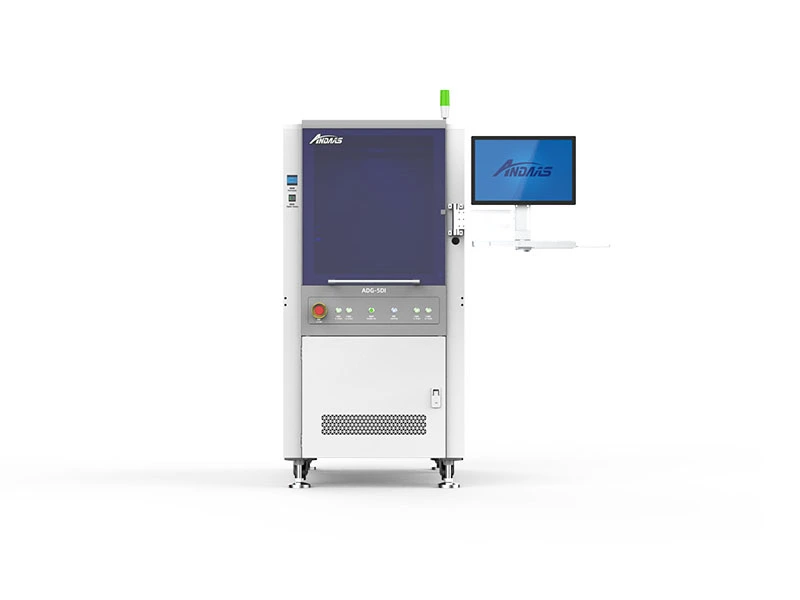
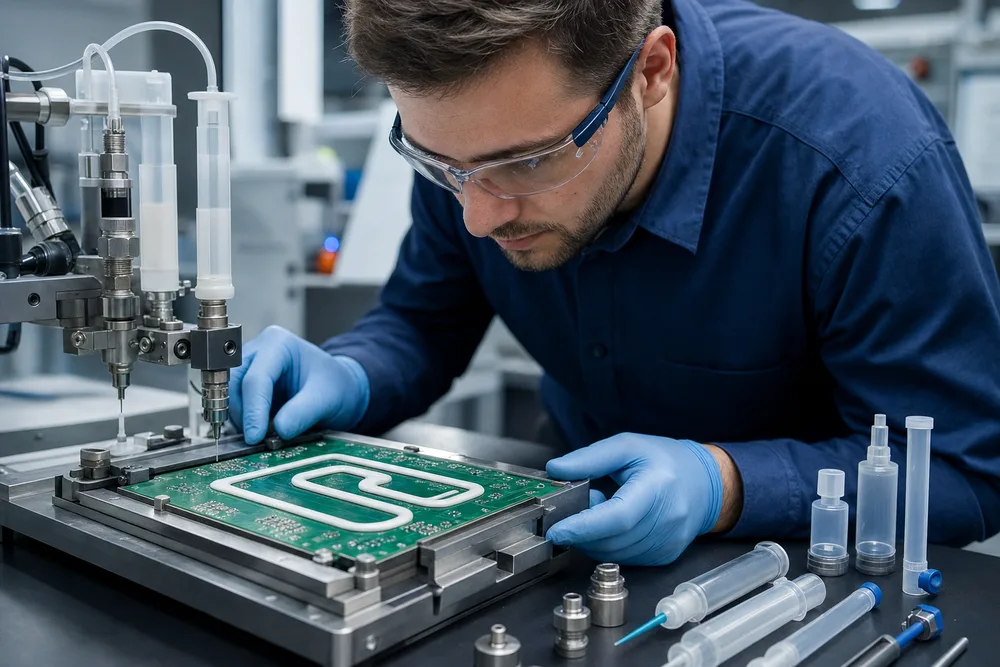
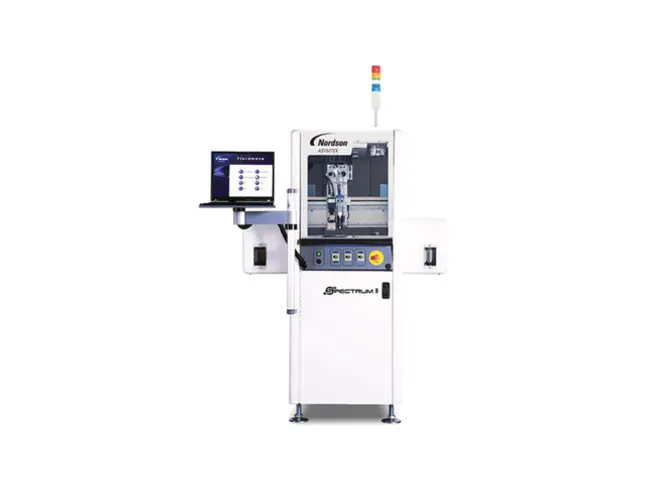
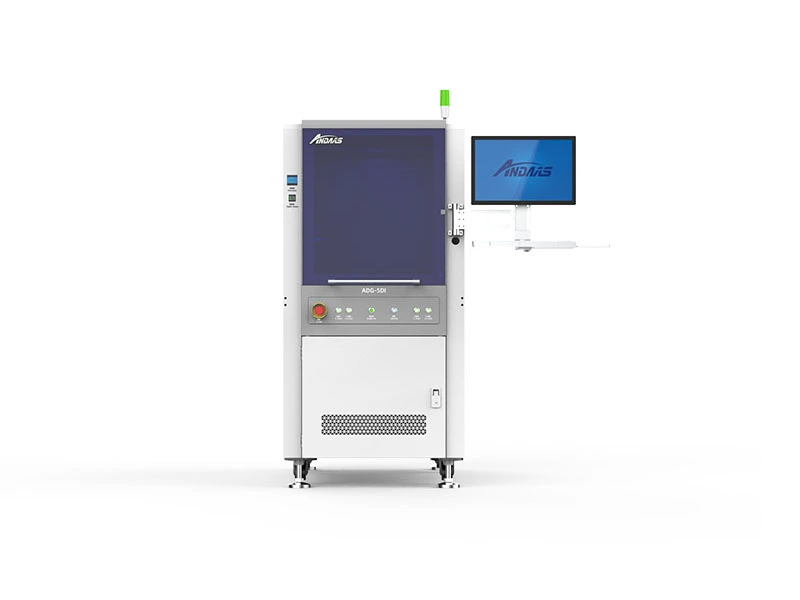
The CHUANGKAIDA ADG-5DI 5-Axis High-Speed Dispensing Machine is designed for automated adhesive application where part geometry, placement accuracy, and repeatable process control matter. Confirmed specifications include a five-axis motion structure, CCD visual positioning, a dual-Y-axis platform, a 200 mm × 200 mm dispensing area, maximum movement speed of 1,000 mm/s, and repeat positioning accuracy of ±0.012 mm.

That specification set makes the ADG-5DI a candidate for electronics, automotive components, semiconductor assemblies, optical products, and other smart-manufacturing applications. It does not, by itself, prove that every adhesive, pattern, cure process, or cycle-time target will work. Those points must be tested with your workpiece and material before you commit to a production configuration. You can review the ADG-5DI machine details while preparing those requirements.

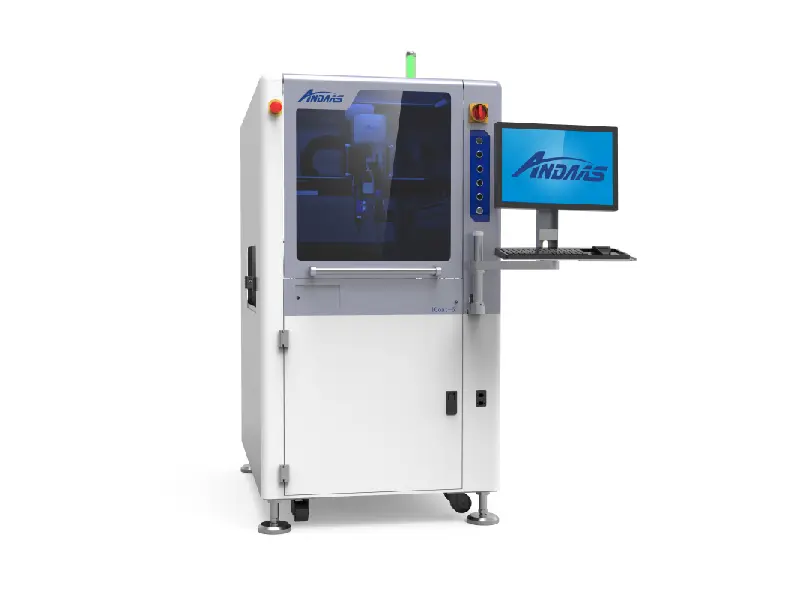
ADG-5DI 5-Axis High-Speed Dispensing Machine

Is the ADG-5DI the right five-axis adhesive dispensing machine for your line?

It is a strong fit when your process needs controlled adhesive placement on parts that are difficult to handle with a simple X-Y table. Five-axis movement can support more complex approach angles and workpiece access, while the vision system helps locate features before dispensing. The machine is also relevant when you are replacing manual glue application with a repeatable automated process.

Buyers should be careful with the phrase “high speed.” The 1,000 mm/s figure is the maximum movement speed, not a guaranteed production rate or dispense speed. Actual output depends on path length, adhesive rheology, valve selection, dot or bead size, inspection time, loading, curing, and any required rework. A short path with a slow-curing material can behave very differently from a dense bead pattern with frequent stops.

The ADG-5DI may be a poor match if your part exceeds the stated 200 mm × 200 mm dispensing area, if your material requires environmental controls not included in the proposed configuration, or if the process depends on a valve and fluid behavior that has not been validated. Those are engineering questions, not brochure details.

What the confirmed ADG-5DI specifications mean for production planning

Motion, positioning, and work-area specifications

The five-axis structure is intended for controlled dispensing on complex assemblies. It gives the motion system more flexibility than a flat two-dimensional path, but the useful question is not simply how many axes the machine has. Ask whether the required nozzle angle, clearance, rotation, and access can be achieved on your actual part without collisions or excessive path time.

The dual-Y-axis platform can support production layouts that require two Y-axis work positions or a specific loading and dispensing arrangement. Its value depends on your fixture design and operating sequence. It should not be treated as proof of simultaneous processing unless that function is included in the quoted configuration.

The usable dispensing area is specified as 200 mm × 200 mm. Check this against the part envelope, fixture edges, fiducial locations, nozzle clearance, and any keep-out zones. A part that technically fits the work area may still be unsuitable if the fixture prevents the nozzle from reaching the adhesive path.

Maximum movement speed is listed at 1,000 mm/s, with repeat positioning accuracy of ±0.012 mm. Repeat positioning accuracy describes how consistently the system can return to a programmed position; it does not automatically equal adhesive bead accuracy. Fluid pressure, needle condition, valve response, material temperature, surface energy, and curing can all affect the final result.

Material capacity, valve choices, CCD positioning, and configurable functions

The ADG-5DI is specified with 30 cc or 50 cc material capacity. Choose the capacity around your material packaging, replenishment interval, viscosity, pot life, and contamination controls. A larger reservoir is not always better. For moisture-sensitive or time-limited materials, holding more fluid can increase waste or create a process-control problem.

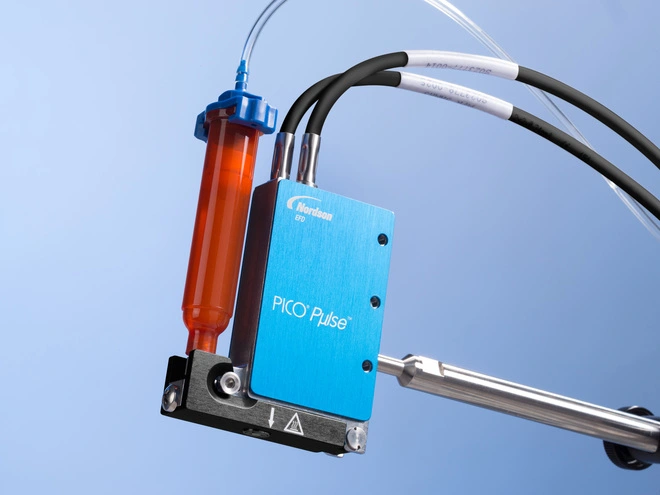
Available valve options include pneumatic jet, piezoelectric, and auger valves. These technologies suit different dispensing behaviors. Jetting can help with non-contact or rapid deposit patterns; piezoelectric systems are often considered for controlled high-frequency deposition; auger valves are commonly evaluated for filled or higher-viscosity materials. The correct choice depends on the adhesive, particle loading, deposit size, substrate, and required contact method.

CCD visual positioning uses camera-based feature location to align the dispensing path with the workpiece. In practice, your team must define usable fiducials, contrast, lighting conditions, allowable part variation, and the correction range needed for each product. Vision can compensate for placement variation. It cannot correct a badly designed fixture, a warped part beyond the available correction range, or an adhesive that spreads after placement.

Applications that can benefit from five-axis dispensing and dual-Y conveying

The machine is positioned for precision adhesive application in electronics, automotive electronics and components, semiconductor assembly, optical products, and smart-manufacturing lines. Typical process discussions may include bonding, sealing, potting, underfill-related work, protective adhesive patterns, or component attachment, but the suitable application must be confirmed through material and pattern trials.

Five-axis access is most useful where a flat nozzle approach creates shadows, awkward fixture requirements, or inconsistent contact. CCD positioning is valuable when component placement or fixture location varies within a controlled range. The dual-Y arrangement may help production engineers organize loading, dispensing, and part movement around the available line layout.

For SMT-related production, confirm the required file format, program transfer method, fiducial strategy, and SMEMA handshaking with the integrator. SMEMA communication can support equipment-to-equipment signaling, but it does not define your complete line-control logic or guarantee compatibility with every upstream and downstream machine.

How to validate adhesive compatibility and dispensing performance before purchase

Test the workpiece, fluid, dispense pattern, and cure process

Request a sample trial using your real substrate, adhesive lot where possible, fixture concept, and target pattern. A useful trial should examine start-and-stop behavior, corners, narrow gaps, changes in direction, dot repeatability, bead continuity, stringing, satellites, tailing, and contamination near sensitive features.

Record the material’s viscosity range, filler content, packaging, storage conditions, working life, cure method, and temperature limits. Confirm whether the proposed 30 cc or 50 cc capacity suits the material. Test the valve type under production-relevant pressure, temperature, and duty-cycle conditions rather than judging it from a single clean deposit.

Define acceptance criteria for accuracy, repeatability, defects, and traceability

Set acceptance criteria before the machine trial. Include positional tolerance, bead width or deposit volume range, minimum and maximum acceptable coverage, voids, bridging, overflow, missed deposits, and cosmetic limits. If the assembly is safety-critical or optically sensitive, define the inspection method and sampling plan with your quality team.

Also decide what must be recorded. Depending on your process, that may include program revision, material lot, valve settings, camera result, alarm history, operator identity, and inspection outcome. The machine’s stated repeat positioning accuracy is useful evidence, but it is only one part of process capability.

Integration, installation, and ownership questions for a US manufacturing site

The listed electrical requirement is 220 V, and the machine supports SMEMA communication. Your facilities and controls teams should confirm voltage configuration, grounding, plant-air requirements if a pneumatic valve is selected, network access, exhaust or ventilation needs, floor space, fixture changeover, and operator access before purchase.

Ask who will install and qualify the equipment, how programs are backed up, what spare valves and wear parts are recommended, and how service issues are handled in the United States. CHUANGKAIDA supplies dispensing equipment and related accessories, and its offering includes installation, spare parts, rental, used equipment, and custom or turnkey services. The exact support package should be written into the quotation rather than assumed.

Ownership cost is shaped by more than the machine price. Include valves, needles or nozzles, reservoirs, fixtures, vision lighting, material handling, preventive maintenance, training, and validation time. A low initial quote can become expensive if the required valve, fixture, or integration work appears later as an unpriced change.

What to include in an ADG-5DI RFQ to receive an accurate configuration

Send the supplier enough process data to select the machine and valve configuration without guessing. Include:

  • Part drawings, 3D files, dimensions, weight, surface materials, and allowable cosmetic areas.
  • Adhesive manufacturer, product grade, viscosity, filler content, packaging, pot life, storage conditions, and cure requirements.
  • Dispense pattern files or marked-up drawings showing dots, beads, paths, keep-out zones, and required deposit tolerances.
  • Target cycle time, shift pattern, annual volume, changeover frequency, and expected uptime.
  • Required fixture concept, fiducial locations, loading method, and whether operators or robots will load parts.
  • Preferred valve technology, if known, plus the reason for that preference and any material compatibility concerns.
  • Inspection, traceability, data export, line communication, SMEMA requirements, and acceptance-test criteria.
  • US site utilities, available floor space, electrical details, training needs, installation timing, and after-sales support expectations.

For a configuration discussion based on your part and adhesive, contact CHUANGKAIDA through the ADG-5DI five-axis dispensing machine page. Include sample parts and material data if a dispensing trial is possible. That is the fastest way to turn the published specifications into a defensible production recommendation and an accurate ADG-5DI quote request.

Related News
Leave me a message
X
We use cookies to offer you a better browsing experience, analyze site traffic and personalize content. By using this site, you agree to our use of cookies.Privacy Policy
RejectAccept